The Real Reason Your Classroom Feels Out of Control (Hint: It’s Not You)
If you’ve caught yourself thinking “What is going on with these kids?” lately — trust me, you’re not alone.
Something has shifted in our classrooms. They feel louder, more emotionally charged, harder to settle. Students seem to escalate faster. Attention spans feel shorter. Even teachers with decades of experience are saying things like, “I’ve never had to work this hard just to keep the room functional.”
It’s easy to point fingers at a single culprit: too much screen time, permissive parenting, pandemic learning loss, lack of accountability. But the real story is more layered — and honestly, more important to understand.
What’s happening in our classrooms isn’t being caused by schools. It’s showing up in them.
Our classrooms have become a mirror for the nervous system state of the world around us.
Schools Don’t Exist in a Bubble — They Reflect What’s Happening Outside
There was a time when stress mostly stayed in the adult world.
Parents and teachers dealt with pressure at work, filtered what they could, and kids experienced a somewhat buffered version of reality. Hard things still happened, but there was more of a boundary between adult anxiety and childhood.
That boundary has dissolved.
Between 24/7 news cycles, social media, economic uncertainty, global crises, and the constant ping of notifications, nothing stays out there anymore.
Stress doesn’t stay at work. It comes home. It comes to school. And it seeps into developing nervous systems that aren’t equipped to process it yet.
Today’s classrooms are holding:
The emotional fallout from stretched families
The ripple effects of financial and social instability
The strain of under-resourced systems
The accumulated tension carried by both adults and kids
Our classrooms are absorbing everything we’re all going through and reflecting it back to us.
Why It Shows Up So Loudly in Kids
Children are still developing the very mechanisms that adults use to mask their stress.
Most adults have gotten really good at:
Stuffing down emotions
Pushing through exhaustion
Smiling when things aren’t okay
Compartmentalizing to get through the day
Kids can’t do that yet and honestly, they shouldn’t have to.
So what adults carry silently, kids express outwardly — through fidgeting, outbursts, defiance, zoning out, or inability to sit still.
It’s not that kids today are worse behaved. It’s that their nervous systems haven’t learned to hide distress yet.
What looks like chaos in a classroom is often unfiltered stress — the same stress adults have learned to suppress until it emerges later as burnout, anxiety, or physical illness.
Allostatic Load: Why Everything Feels Heavier Now
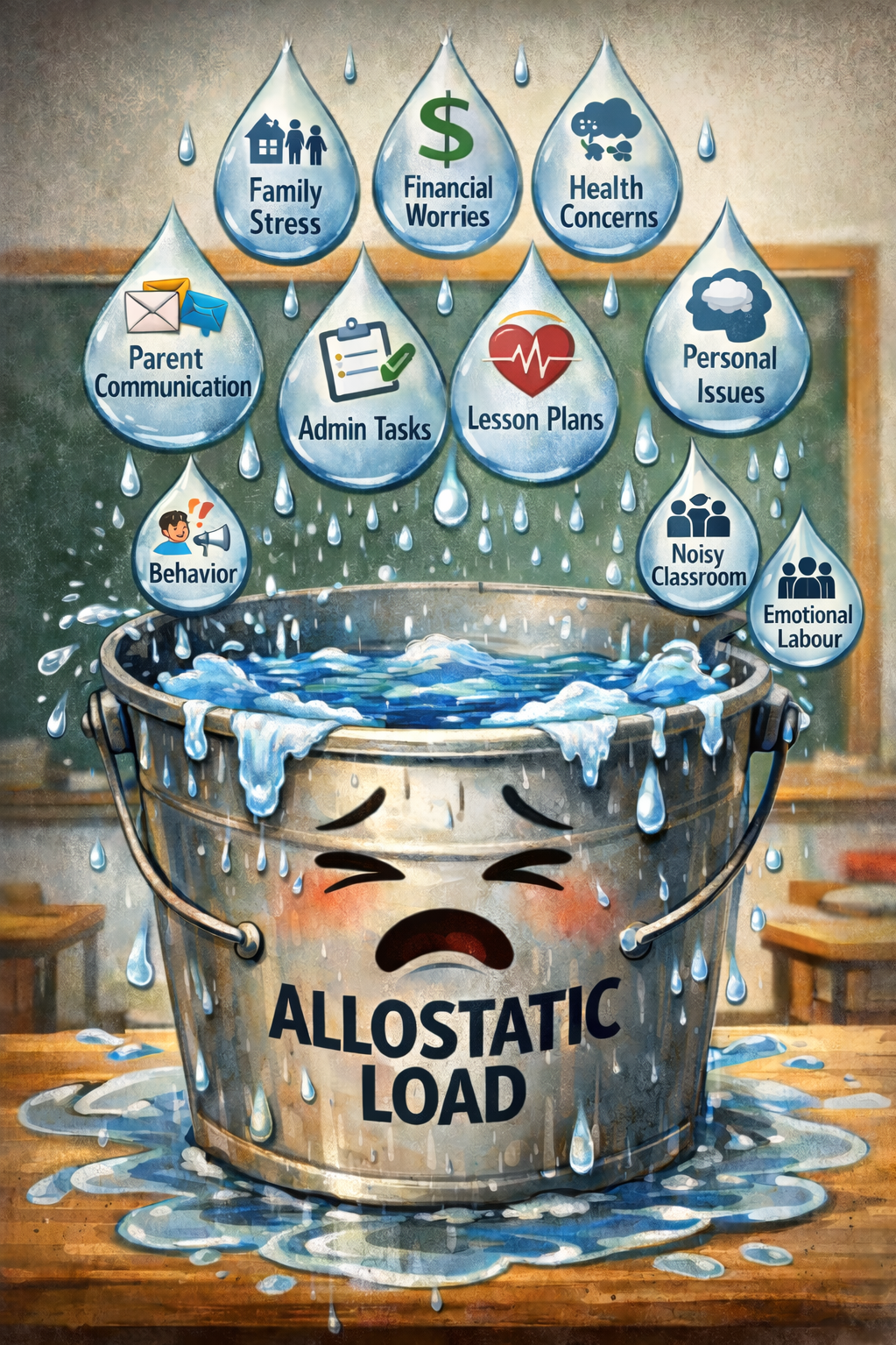
There's actual science behind why everything feels harder right now. It's called allostatic load.
Allostatic load is the cumulative wear and tear on your body from ongoing stress. Not from one big traumatic thing, but from never actually getting back to baseline. Imagine a bucket, and every time it rains drops of water fill it up. When the rain stops, the water can evaporate and there is space in the bucket for new water once it rains again. Now imagine that the water never has a chance to evaporate. There isn’t enough time in between storms for any water to leave. The bucket begins to overflow. It never has a chance to fully rest and reset.
For kids, this builds from constant stimulation and information overload. Their schedules are packed. Social media has them comparing themselves to everyone, all the time. Some are dealing with unpredictable home situations. And nobody's getting real rest anymore.
For teachers, it's being on all day with no actual breaks. You're managing behavior while also trying to teach. You're doing the emotional labor of holding space for twenty or thirty kids while staying composed no matter what's happening. And there's never enough time to actually decompress before you have to do it all again tomorrow.
When your bucket stays full like this, your nervous system loses its flexibility. You have a shorter fuse and get frustrated faster. Small things trigger bigger reactions than they should. You can't focus or control your impulses the way you normally would. You feel emotionally overwhelmed. You're exhausted in a way that sleep doesn't touch. And over time, your body starts breaking down with stress-related chronic conditions.
Your body is responding exactly as designed when the bucket never gets a chance to empty.
Why Old-School Classroom Management Strategies Aren’t Landing
Many of the behavior management techniques we rely on were designed in a different era, when baseline stress levels were lower and nervous systems had more capacity to respond. We're now trying to apply those same strategies to bodies that are already maxed out.
When nervous systems are overloaded, sticker charts and rewards lose their appeal. Consequences just escalate conflicts. Telling a kid to "just try harder” actually makes things worse. Compliance-based approaches trigger more resistance instead of cooperation.
Structure is still important. But regulation has to come first. When a nervous system is flooded, there's nowhere for structure to land. And academic learning becomes nearly impossible to hold when your body is stuck in survival mode.
Nervous System Regulation is More Than a Buzzword
Regulation doesn't mean being calm and quiet all the time. It means having enough internal capacity to bounce back after something hard instead of staying stuck there. It means you can stay present in the moment instead of mentally checking out. You can respond thoughtfully instead of just reacting on autopilot. You can handle challenge without completely falling apart.
In classrooms, nervous system regulation is what makes everything else possible. When nervous systems are regulated, learning can happen. Behavior settles. Relationships deepen. Teacher wellbeing becomes sustainable instead of something you're constantly sacrificing.
You don't regulate a classroom by trying to fix individual kids one at a time. You regulate a classroom by creating conditions that support everyone's nervous systems—and that work starts with your own.
What This Actually Means for Teachers
I know you’re already doing too much. This isn’t about piling more onto your plate. That’s the last thing any one needs.
It’s about shifting where we put our energy.
Small, consistent moments of regulation — what I call micro-resets — can gradually lower allostatic load. They create a little breathing room in systems running on fumes.
This is why things like grounding exercises, sensory breaks, predictable routines, and movement matter. They align with how our bodies actually work.
When regulation is woven into the fabric of your day, everything else becomes more manageable.
There’s a Path Forward
There’s nothing wrong with today’s students.
What we’re seeing in classrooms is a reflection of a world that’s become faster, more chaotic, and heavier, without giving anyone the tools to cope with that reality.
Schools aren’t the source of the problem. They’re just where the truth becomes visible first.
And that also means they’re where real change can start.

Ready to Start Regulating Your Classroom? Get Your Free Micro-Reset Guide
If you’re wondering “okay, but what do I actually do with this?” — I’ve got you.
I’ve created a free, practical guide specifically for teachers. You can also use many of these practices for yourself and with your students.
No complicated protocols. No extra planning time. Just practical, body-based tools that work with your day, not against it.
