5 Clay Activities to Calm Anxious Students
If you've ever watched a visibly anxious child sit down with a ball of clay and slowly, almost magically , start to breathe again, you already know what the research confirms: working with clay is one of the most powerful sensory regulation tools we have in the classroom.
Clay engages the hands, quiets the nervous system, and gives students something concrete to focus on when their thoughts are spiralling. The best part? It doesn't require an art degree, a big budget, or a lot of prep time. And you likely already have access to clay, Playdoh, plasticine or some type of sculpting dough in your classroom. These five activities can be woven into your school day whenever your students need to reset, but I love having a stand alone Clay Lab in my classroom that students access during literacy or math centres. It helps build regulation into the day as well as fine motor skills, creative expression and problem solving. There is so much that clay offers us!
Why Clay Works for Anxious Students
Before we dive into the activities, it's worth understanding why clay is so effective. Anxiety often lives in the body — tight chest, racing heart, restless hands. Clay gives those hands something purposeful to do.
The repetitive squeezing, rolling, and pressing motions activate the parasympathetic nervous system (your body's "rest and digest" mode), which naturally counteracts the stress response. It's tactile, it's grounding, and it's self-paced — there's no right or wrong answer with clay, which removes the performance pressure that often fuels anxiety in the first place.
If you want to dive even deeper into the benefits of clay and the neuroscience behind it, I wrote a blog article detailing all of that and more here.
Activity 1: The Squeeze and Breathe Ball
Best for: Quick resets, individual students, transition times
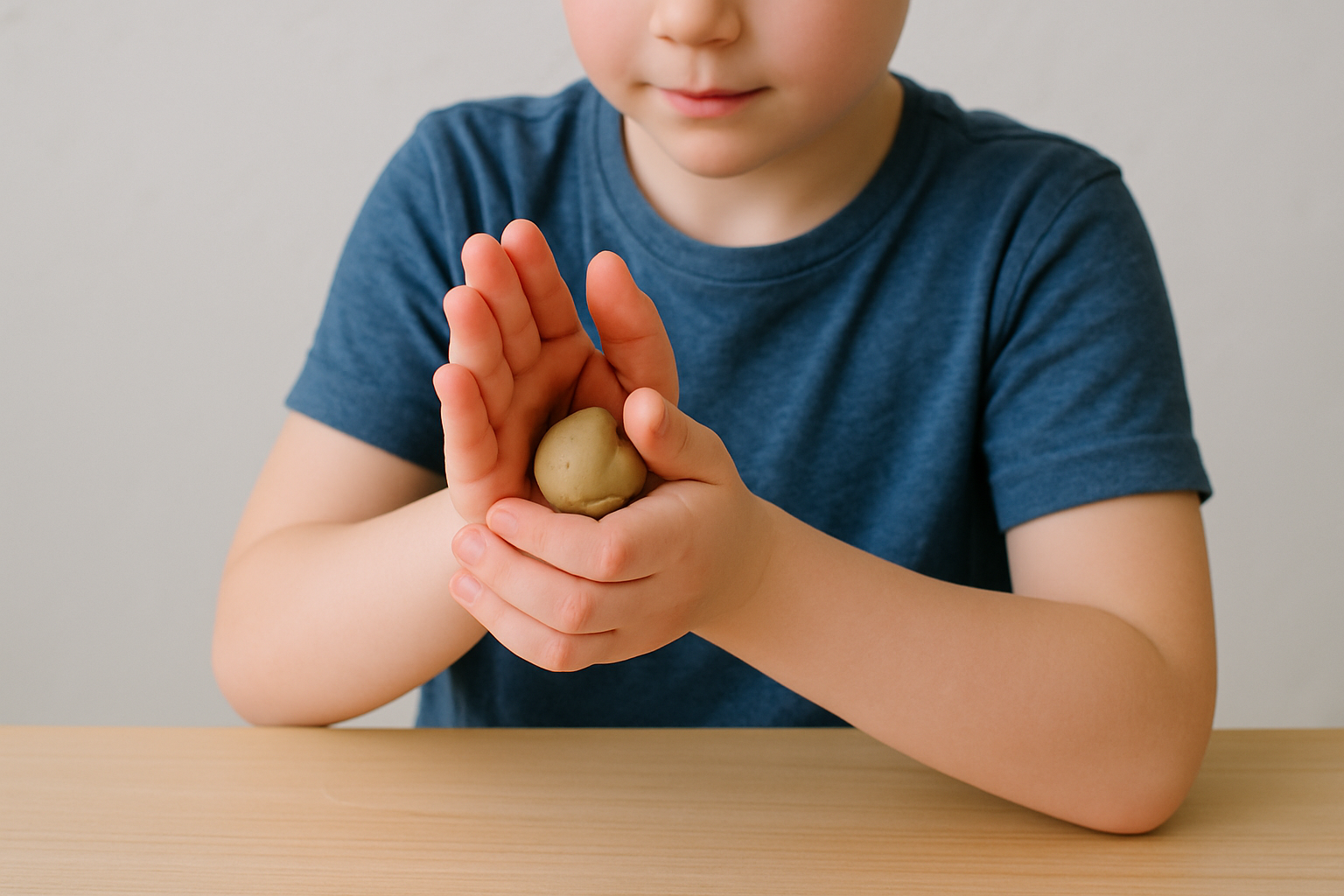
This is the simplest activity on the list, and often the most effective for acute anxiety. Ask your student to roll their clay into a smooth ball and hold it in both hands.
Then guide them through this: Squeeze the ball as you breathe in for 4 counts. Hold for 4. Release your grip slowly as you breathe out for 4. Repeat 5 times.
The physical act of squeezing gives the anxiety somewhere to go. Paired with breathwork, it becomes a full-body calming tool that students can use independently once they've practiced it a few times.
Tip: This works beautifully as a class-wide activity after lunch or during a rough afternoon. Even students who aren't visibly anxious benefit from the reset.
Activity 2: Worry Stones
Best for: Chronic worriers, students who need a transitional object
Have students flatten a small piece of clay into an oval shape and use their thumb to press a smooth indentation into the center — just like a real worry stone. While they work, invite them to press their worries into the clay.
Once dry, students can keep their worry stone in their pocket or at their desk. The act of rubbing the indentation with their thumb becomes a self-soothing gesture they can use discreetly during class.
This activity is especially meaningful when you pair it with a brief conversation: "What's something you've been carrying around lately that feels heavy?" You don't need the student to share out loud, just the act of naming the worry (even privately) while shaping the stone gives the anxiety a form, and therefore a boundary.
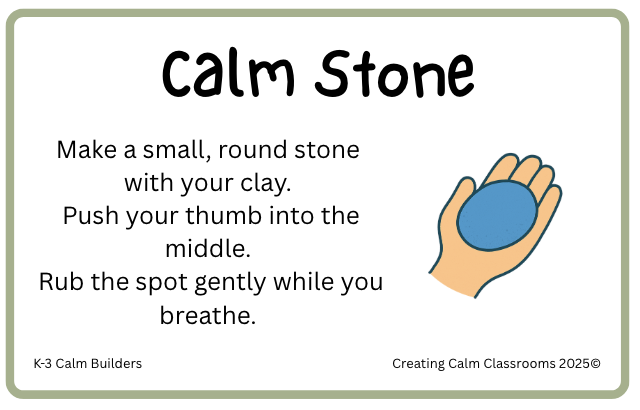
Sample activity card from the Classroom Clay Lab, showing how regulation can be built into everyday classroom moments. Download all 30 cards here.
Activity 3: Emotion Faces
Best for: Students who struggle to identify or name their feelings
Sometimes anxious students can't find the words for what they're feeling. Clay gives them a different language.
Ask students to sculpt a simple face that shows how they feel right now — no artistic skill required. Big eyes, a droopy mouth, furrowed brows — whatever feels true. Then invite them (if comfortable) to make a second face showing how they want to feel.
This activity supports emotional literacy and gives you a window into how a student is doing without putting them on the spot verbally. It's also a great starting point for a gentle one-on-one check-in.
Tip: Keep a small feelings chart nearby so students have vocabulary to reference as they work.
Activity 4: The Calm Place Sculpture
Best for: Ongoing anxiety management, visualization practice
This is a slightly longer activity, perfect for a calm-down corner, indoor recess, or a designated mindfulness block.
Ask students to close their eyes and think of a place (real or imaginary) where they feel completely safe and calm. It might be their grandmother's kitchen, a treehouse, the beach, or somewhere totally made up. Give them time to really picture it.
Then invite them to build it out of clay. It doesn't need to be detailed or realistic, a lumpy mountain with a tiny figure on top is just as valid as an intricate scene.
The power here is twofold: the visualization practice itself is calming, and students end up with a physical reminder of their safe place that they can keep at their desk or in their calm-down kit.
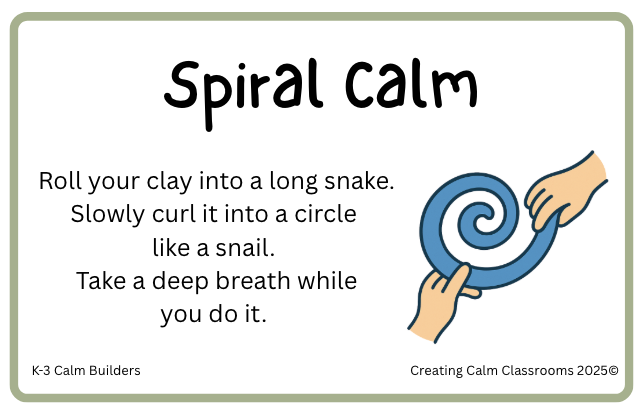
A sample clay activity card from the Classroom Clay Lab used in classrooms to support calm, focus, and emotional processing through tactile work. Download the pack here.
Activity 5: The Untangle Snake
Best for: Students who are visibly tense, frustrated, or overwhelmed
This one requires almost no instruction, which makes it ideal for a student who is too dysregulated to follow complex directions.
Hand them a piece of clay and simply say: "Roll this into a long snake — as long as you can make it without it breaking."
The slow, steady, even pressure required to roll a clay snake without it tearing is inherently regulating. Students have to slow down and focus. It also gives you a natural entry point for conversation once they've had a minute to calm: "That took real patience. How are you feeling?"
If you want to add a layer, you can invite them to coil the snake into a spiral when they're done — a visual metaphor for bringing the chaos back to center.
A Few Practical Notes
You don't need expensive pottery clay for any of these activities. Air-dry clay, Model Magic, or even homemade salt dough all work well. Use what you already have on hand in your classroom. Keep small portions stored in airtight bags or containers so they stay workable.
If you're working with a calm-down corner, a small tub of clay with a printed activity card is a self-sufficient station students can visit independently so no teacher facilitation needed.
Want a No-Prep Version of These Activities?
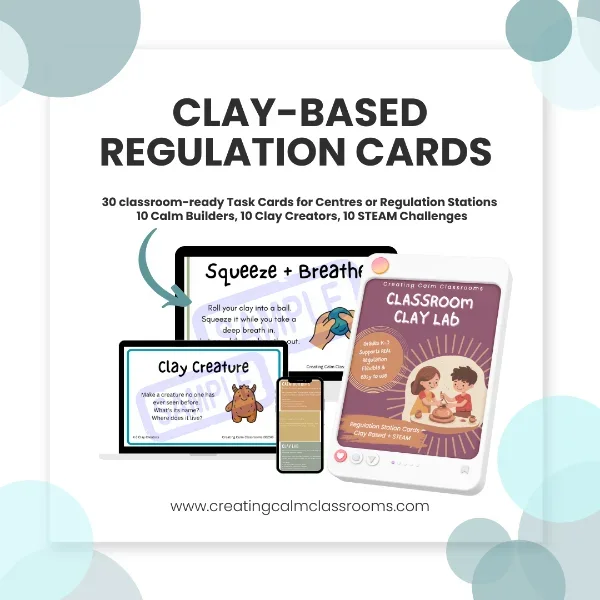
If you love these ideas but want something you can hand to students immediately — without cutting, laminating, or gathering supplies — my Classroom Clay Lab resource has you covered.
Each card walks students through a calming clay activity with simple visual instructions, making them perfect for calm-down corners, early finishers, or sensory breaks. Students can work through them independently while you keep the rest of your class running smoothly.
[👉 Grab the Clay Cards: Print and Go here]
Your students deserve tools that actually work and you deserve a classroom that feels calm. These cards are a simple step toward both.
Save this post for later — pin it so you can find it when you need it most.
